Category: RV

  • Indoor vs. Outdoor vs. Covered Storage: Which Is Right for Your Boat or RV?

    Indoor vs. Outdoor vs. Covered Storage: Which Is Right for Your Boat or RV?

    The first warm Saturday in April, you peel the cover off the boat and a mouse bolts from a nest in the captain’s chair. The vinyl is shredded, the wiring underneath is chewed, and the season has not even started. That morning was decided back in October, by one choice: where it spent the winter.

    The cheapest storage option in central Minnesota is a spot in your driveway. It is also the most expensive one, because that is where the freeze damage, rodent chewing, and sun-baked gel coat get done. Where you park a boat or RV for the off-season decides how much of it survives to next spring.

    Central Minnesota is thick with rigs that need an off-season home. As of 2025, Minnesota ranks first in the nation for registered boats per capita, roughly one for every six residents, [1] and RV makers shipped 342,220 units nationwide in 2025. [2] Most of them sit unused for months, and where they sit is the whole question.

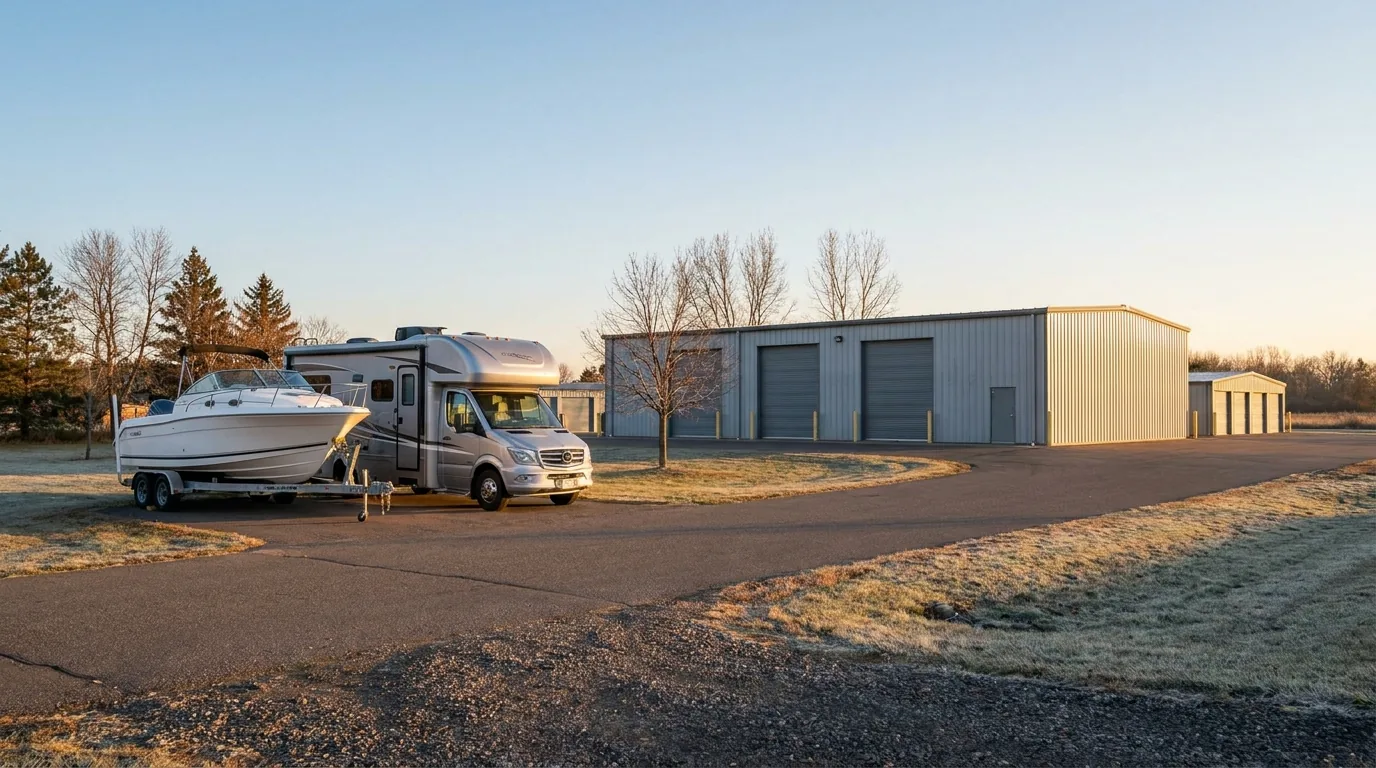
    Storage comes in three flavors: fully enclosed indoor units, open-sided covered canopies, and open-air outdoor lots. Each has a price, and each has a real cost that shows up months later. This guide walks through what you actually get for the money, so you can match the option to the boat or RV instead of the sticker price.

    What Are Your Three Storage Options?

    Storage facilities usually market three tiers, and knowing which tier you are looking at prevents a lot of surprise the first winter. The names get used loosely, so it helps to define them the way the industry actually does.

    Indoor Storage (Fully Enclosed)

    Indoor units are walled and roofed, with a lockable door. You back the boat or RV in, close the door, and it sits in a sealed bay for the off-season. Premium indoor units include electricity, drive-in access, and door heights that fit tall coaches and pontoons.

    What you get: no snow load, no UV, no wind-driven rain, and a much smaller opening for rodents to find. What you pay: the highest per-month rate of the three options, offset by the fact that you skip most weather-related repair bills.

    Covered Storage (Canopy)

    Covered spots have a roof and often side walls on one or two sides, but the ends and at least one long side are open. Think of a pole barn without full walls. Snow load lands on the canopy instead of the rig, and the sun does not hit the deck directly.

    What you get: solid protection from snow load and UV, plus a break from most precipitation. What you pay: less than indoor, more than open outdoor. What still gets in: blowing snow, blowing dust, road-salt spray, and small animals looking for shelter.
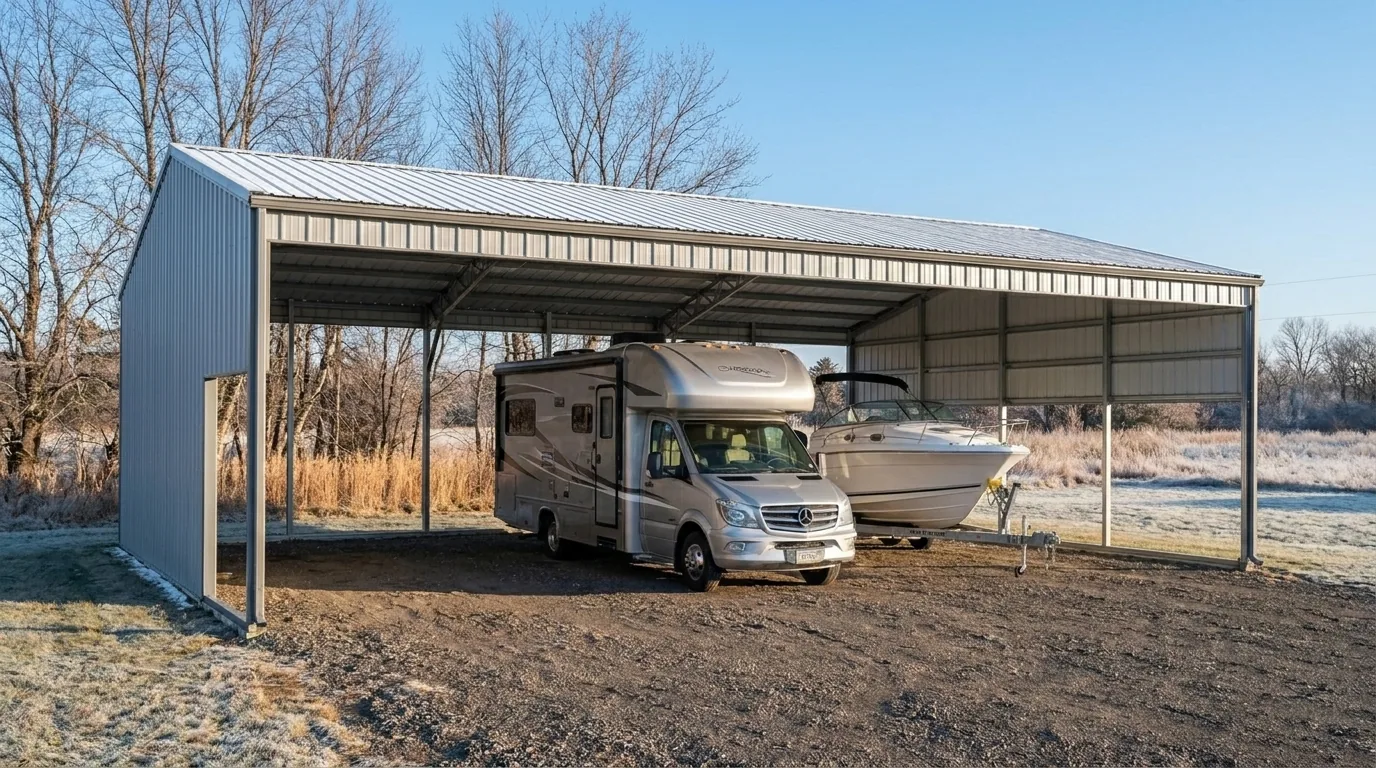
    RV and boat parked under an open-sided steel canopy with snow on the roof at a central Minnesota storage facility
    A canopy takes the snow load and blocks direct sun, but the sides stay open to wind and pests.

    Outdoor Storage (Open Lot)

    Outdoor storage is a marked parking spot or a section of gravel or asphalt with no roof or walls. It sits under the sky for six to seven months.

    What you get: the lowest monthly cost, plus easy back-in and pull-out access. What you pay: everything else. Snow accumulates on the cover, sun bakes the finish, freeze-thaw cycles work the seams, and rodents get a wide-open runway.

    How Much Protection Does Each Option Actually Offer?

    Protection breaks down into four things a boat or RV cares about: freeze exposure, snow load, UV and weather, and rodent pressure. Here is how the three storage types stack up on each.

    Factor Indoor Covered Outdoor
    Freeze exposure Same as outside air (unheated units), but no wind chill or blowing snow on seals Same as outside, some wind protection Full exposure, wind chill, freeze-thaw hitting every seam
    Snow load Zero on the rig Zero on the rig; canopy takes the weight Heavy load risk on covers, roofs, and frames
    UV and weather Fully shielded Roof blocks direct sun and rain Continuous UV, rain, and salt spray
    Rodent pressure Low; single entry point Moderate; open sides invite small animals High; no barrier at all

    Notice what indoor storage does not do: it does not heat the space. Most indoor storage in central Minnesota is unheated, so the interior temperature still drops well below freezing on a January night. That is why winterization matters regardless of where it spends the winter.

    What indoor storage does do is remove everything else. No snow load on the roof, no UV on the gel coat, no blowing salt on the aluminum, no rodent freeway from the field next door. It sits in still, dry air for seven months.

    What Does Storage Cost in Central Minnesota?

    Prices swing quite a bit between facilities and unit sizes, but the general shape holds. Outdoor lots run the cheapest, canopies sit in the middle, and enclosed indoor bays cost the most. Location matters too: units close to the highway with easy access typically list higher than remote lots that require a longer drive to reach.

    Rough monthly ranges for secure boat and RV storage near St. Cloud, whether you own a boat, an RV, or a camper:

    • Outdoor lot: $40 to $90 per month, depending on lot access and whether the surface is gravel or paved.
    • Covered canopy: $75 to $150 per month, usually with basic electrical shared across the row.
    • Indoor unit: $125 to $280 per month for premium sizes from 11×22 up to 14×40, typically with individual electricity and drive-in access.

    The math changes when you fold in what each option costs when something goes wrong. When BoatUS analyzed roughly a decade of its marine insurance freeze claims, more than 75% involved a cracked engine block or exhaust manifold, and the group estimates improper storage causes over $50 million in preventable damage nationwide every year. [3]

    A single cracked block can total an older outboard. Replacing one commonly runs well above $10,000 before labor. Set that against the roughly $120 per month gap between outdoor and premium indoor storage over a seven-month layup, and the “expensive” option starts to look like the cheap one.

    Which Storage Type Wins for a Minnesota Winter?

    Winter is where the three tiers separate the most. St. Cloud sits below freezing for just over three months a year, from late November into early March, and in the 1991–2020 climate normals its average January low sits near 2.9°F. [4] Water expands about 9% when it freezes, [5] with enough force to crack a cast-iron engine block. [3]

    Add the two facts together and any water left in the engine, cooling system, or water lines becomes a repair bill. That is true whether it winters indoors or outdoors, which is why full winterization is the price of entry either way. Where storage type matters most is in the second layer of damage: the roof, the finish, the interior, and the electrical.

    Outdoor storage catches all of it. A February snowstorm dumps eight inches on the cover, the sun warms it in the afternoon, it refreezes overnight, and by March the seams under it have been worked loose. Mice hop up from the field, find a gap, and spend the winter nesting in the cushions.
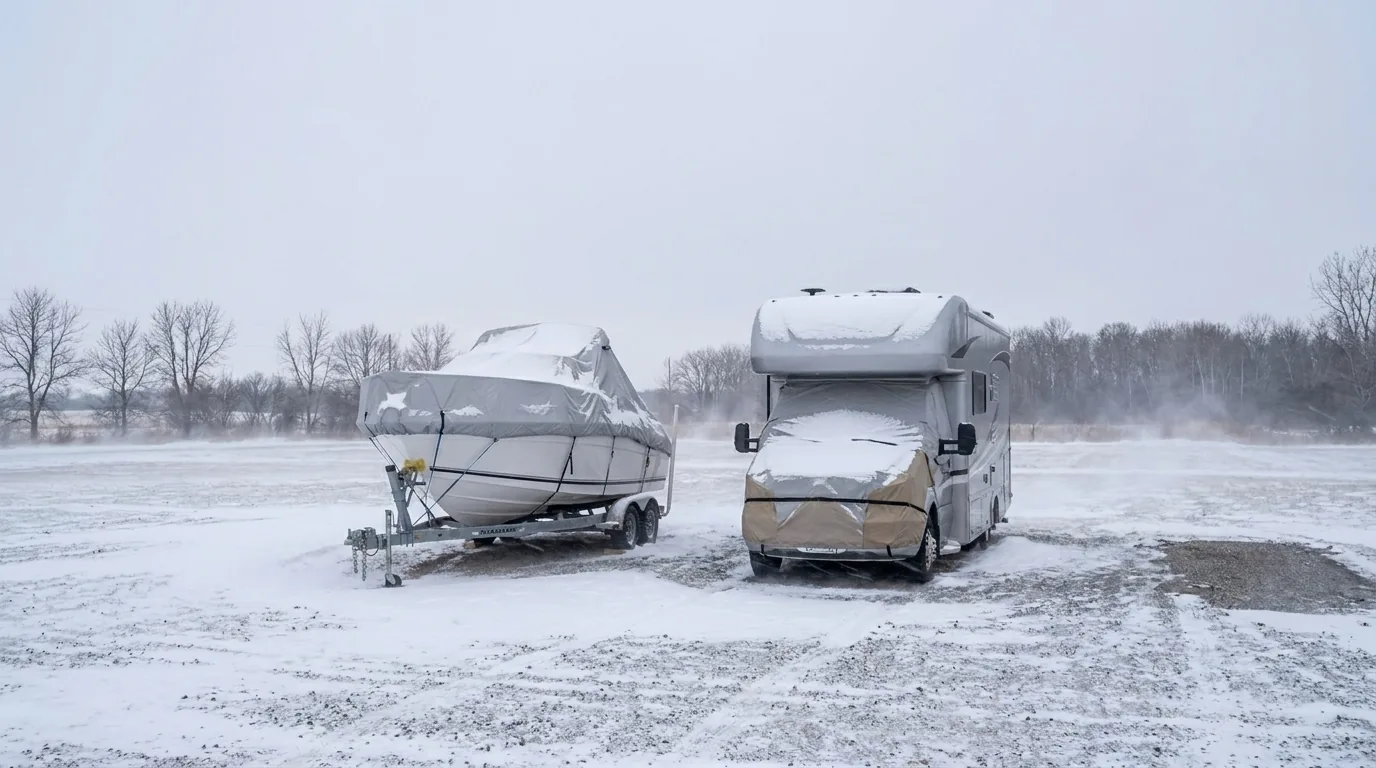
    Covered boat and travel trailer under deep snow on an open outdoor storage lot in Minnesota winter
    On an open lot, snow piles on the cover and freeze-thaw works every seam all winter.

    Indoor storage removes those variables at once. The cover, the tires, and the electrical harness look the way they did in October, because nothing has been working on them all winter. If you are already going to winterize the RV or the boat, indoor storage is what protects the work you just did.

    What About Summer Storage?

    Summer is easier on a stored rig, but not free. Sun exposure adds up fast on vinyl seats, gel coat, and tire sidewalls, and one that sits three weeks between weekend uses in a full-sun outdoor lot ages noticeably in one season.

    Frequent-use owners often park outdoor during the boating and camping months, when the boat or RV is out on the water or on the road most weekends. Occasional-use owners tend to keep indoor storage year-round so the finish and the interior stay showroom clean between longer gaps.

    Covered storage splits the difference well in summer. The roof blocks direct sun and the daily rain hits the canopy instead of the deck, and the open sides let air circulate so nothing stays damp. If it lives outdoors during the season, a canopy spot is a small upgrade with a real payoff for the finish.

    How Do You Choose the Right Option for Your Rig?

    Match the storage tier to what you own and how you use it, then check that the bay actually fits the rig; our guide to what size storage unit you need walks through the dimensions. The bigger the investment and the longer the layup, the more indoor storage makes sense.

    A rough sorting rule:

    • Choose indoor if the rig is worth $30,000 or more, sits for four or more months at a time, has a battery you want on a maintainer, or has soft goods (vinyl seats, canvas, custom interior) you want to protect.
    • Choose covered if you want a middle-tier upgrade over open outdoor, or if it is used frequently in the off-season and you mostly need snow-load and UV protection.
    • Choose outdoor if the boat or RV is inexpensive to replace, you keep an eye on it through the winter, and you are comfortable with a full winterization routine and a high-quality cover.

    There is a fourth factor most owners forget: HOA rules and city ordinances. A lot of central Minnesota neighborhoods cap how long an RV or boat can sit in a driveway, and some ban them entirely. If the driveway is not really an option, the choice narrows to which paid storage tier fits the rig and the budget.

    What We See at Due North Storage

    The pattern is consistent every spring. The rigs that come out ready to launch or roll are almost always the ones that spent the winter indoors, whether that is with us or in an owner’s shop. The rigs that come in for surprise repairs almost always spent the winter outside under a tarp.
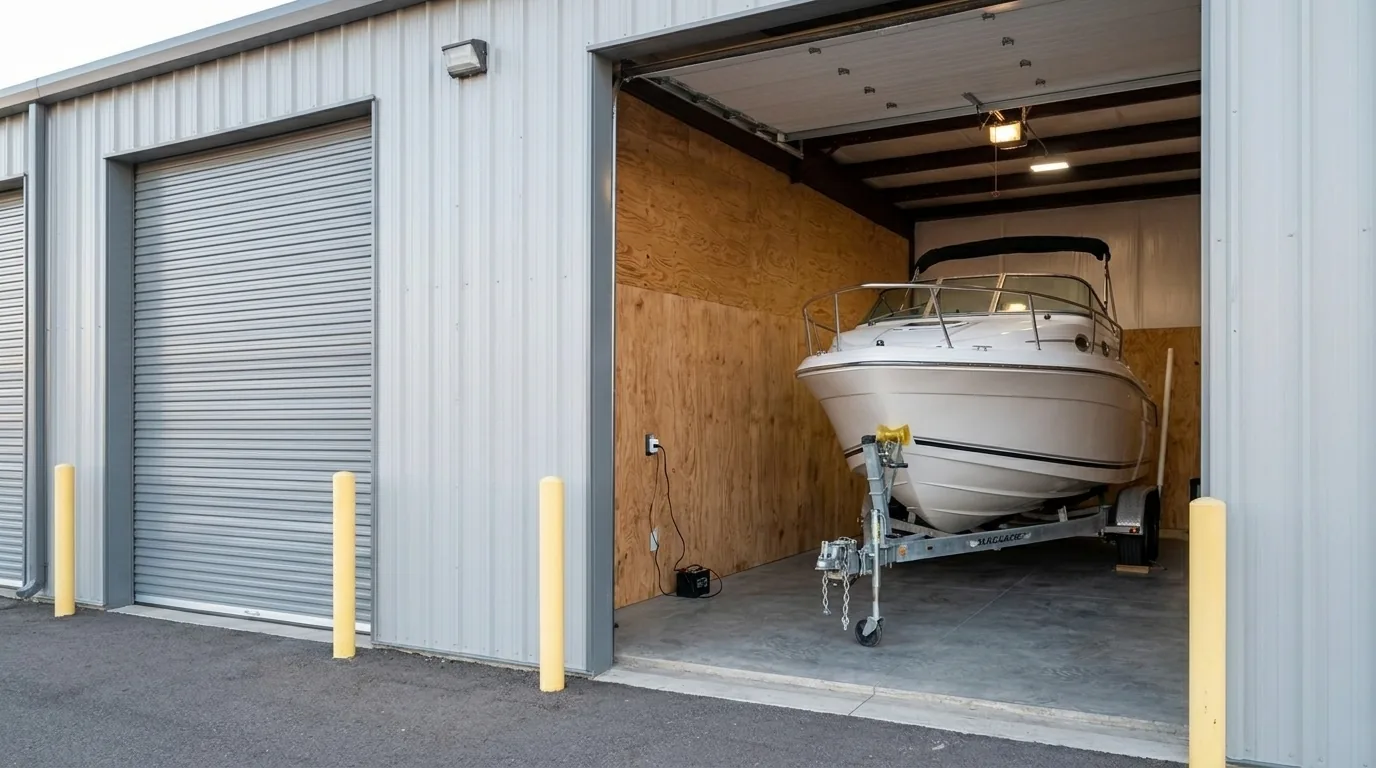
    Boat on a trailer inside a clean enclosed indoor storage unit with the door open
    An enclosed unit keeps the boat or RV in still, dry air, with an outlet for a battery maintainer.

    Freeze damage gets the headlines because it is the most expensive single failure, and that piece is preventable with proper winterization regardless of storage. What indoor storage prevents is the slow-motion damage: the faded gel coat, the mildew on the seats, the mouse-chewed wiring harness, the cracked cover seam that leaked water into the cabin from December through March.

    Owners tell us the calm feeling is worth as much as the physical protection. You are not checking the weather app after every storm to see if you need to sweep the roof. The rig is safe, dry, and ready when you are.

    Store Indoors This Season

    Due North Storage offers indoor units up to 14×40 with electricity included, just off Highway 10 in the St. Cloud area. Skip the snow load, the freeze-thaw, and the spring surprises.

    Final Thoughts

    The right storage tier is the one that matches the value of the rig and the length of the layup. Outdoor is cheap and honest about what it delivers. Covered is a real upgrade for snow load and UV, but leaves the sides open. Indoor costs the most up front and, for most Minnesota owners, quietly pays for itself over one bad-luck winter avoided.

    Whatever you choose, do the winterizing work in October. The rig that arrives at storage properly prepped comes out clean in April. The rig that skips those steps comes out with a repair estimate. Where it sleeps decides how much of the season it costs you.

    Frequently Asked Questions

    Is indoor storage worth the extra cost in Minnesota?

    For most boat and RV owners, yes. Indoor storage removes snow load, UV, and rodent pressure, and units with electricity keep the battery on a maintainer all winter.

    Given that a replacement outboard can top $10,000, the price gap between outdoor and indoor storage usually pays for itself the first spring you skip a weather-related repair.

    Does a covered outdoor space protect against Minnesota cold?

    A canopy blocks snow and UV, but the air temperature inside is still the outside temperature. Freeze damage happens the same way under a canopy as in the open, so you still need to fully winterize the rig.

    Covered storage is better than open outdoor, but it is not a substitute for winterization.

    How much does boat or RV storage cost in central Minnesota?

    Outdoor lots typically run the lowest, covered canopies sit in the middle, and indoor units cost the most. In the St. Cloud area, indoor vehicle units generally range from about $125 to $280 a month depending on size.

    Premium features like electricity, drive-in access, and 14×40 door heights are usually included in that range.

    Can I skip winterizing if I use indoor storage?

    No. Most indoor units are unheated, so the interior temperature still drops well below freezing on a January night. Winterize the water system, stabilize the fuel, and store the battery correctly regardless of where the rig sleeps.

    Indoor storage protects the exterior and interior; winterization protects the mechanicals.

    Which storage type is best for a pontoon?

    Indoor storage suits pontoons best because it eliminates the snow load that crushes covers, blocks the UV that fades vinyl seats, and keeps out the mice that shred foam cushions.

    If indoor is not available, a properly vented shrink-wrap job under a canopy is the next best option.

    Does outdoor storage void my RV or boat insurance?

    Not usually, but many policies exclude freeze damage and rodent damage as preventable maintenance rather than covered losses.

    Read your policy before deciding: some insurers offer premium discounts for indoor storage, and the payout picture on a claim often looks very different between outdoor and indoor storage.

    Do I need indoor storage in the summer too?

    Not always, but sustained sun exposure damages gel coat, vinyl, and tires faster than most owners realize. If your rig sits for weeks between uses in a sunny lot, indoor storage adds meaningful lifespan.

    Frequent-use owners often park outdoor in summer and switch to indoor for winter.

    Indoor Boat & RV Storage in Central Minnesota

    Clean, dry indoor units up to 14×40 with electricity included, off Highway 10 near Saint Cloud and Little Falls. Get your rig into a bay before the season fills up.

    Sources:
    [1] Minnesota Department of Natural Resources. Boating, Canoeing and Kayaking (Minnesota Facts). Updated May 2025. Retrieved 2026-07-28.
    [2] RV Industry Association. RV Shipments End 2025 at 342,220 Units, Modest 2.5% Growth Over 2024. December 2025. Retrieved 2026-07-28.
    [3] BoatUS. Your Boat Engine’s Chillin’ (Winterizing). Retrieved 2026-07-28.
    [4] NOAA / National Weather Service, via St. Cloud State University Climate Office. January Normal Data for Saint Cloud, Minnesota (1991–2020). Retrieved 2026-07-28.
    [5] U.S. Geological Survey, Water Science School. Water Density. Retrieved 2026-07-28.
  • How to Winterize Your RV for a Minnesota Winter: The Complete Storage Checklist

    How to Winterize Your RV for a Minnesota Winter: The Complete Storage Checklist

    The most expensive mistake an RV owner can make in Minnesota costs about two gallons of antifreeze to avoid. Skip it, and the first sound you hear in spring is water spraying behind a wall you can’t reach.

    Water expands by about 9% when it freezes. [1] That one fact is the reason a forgotten cup of water in a low-point drain line can split a fitting wide open by February.

    In central Minnesota, winterizing isn’t a maybe. It’s the difference between rolling out clean in May and opening the door to cracked pipes, a dead battery, and a chewed-up wiring harness.

    This is the full checklist we walk customers through every fall. Work top to bottom and your rig will be ready when the roads thaw.

    Why Minnesota Winters Are Brutal on a Stored RV

    St. Cloud sits below freezing for just over three months a year, from late November into early March. The average January low is about 5°F. [2]

    That’s the average. Minnesota’s all-time record low is 60 below zero, set at Tower in 1996. [3] Your RV plumbing has to survive whatever the season throws at it, not the typical day.

    Here’s the physics that makes it dangerous. As water freezes inside a sealed pipe, it expands and pushes the remaining liquid into a smaller and smaller space.

    Once ice blocks the line, University of Illinois research found that trapped water pressure behind the blockage can climb to about 4,000 psi. [4] Copper, PEX, and plastic fittings all give out long before that. The crack you find in spring was set in motion on the first hard freeze.

    When Should You Winterize Your RV in Minnesota?

    Do it before the first sustained freeze, not after. Around St. Cloud, the first fall freeze typically lands in the last week of September. [5]

    You don’t need to panic at the first frost. But once overnight lows start dipping into the 20s and staying there, your window is closing.

    RV pipes can freeze in a single cold night once temperatures drop into the teens. If your rig is already parked and you’re waiting on a free weekend, move it up the list. October is the safe month to have everything done in our area.

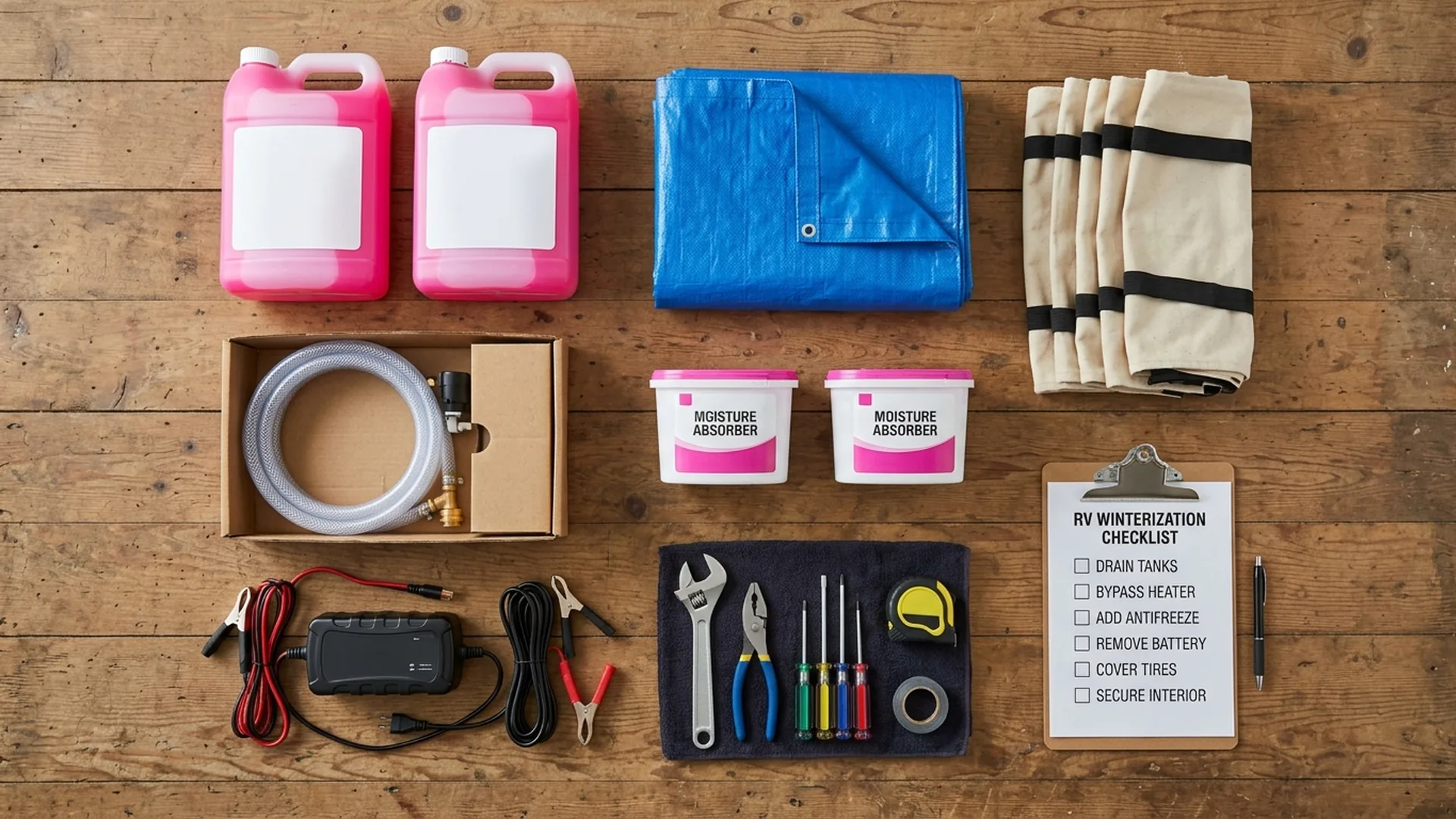
    RV winterization supplies and a checklist laid out on a workbench, including pink antifreeze, a pump kit, tire covers, and a battery tender

    How Do You Protect the Water System from Freezing?

    The plumbing is where winter does the most expensive damage, so this is the part to slow down on. The job has three stages: drain, bypass, then fill the lines with antifreeze.

    Drain Everything First

    Start with empty tanks. Dump the black tank, then the gray tank, then drain the fresh water tank completely.

    Open both the hot and cold low-point drain lines. Open every faucet, inside and out, including the outdoor shower and the toilet valve. You want gravity to pull out as much water as it can.

    Run the water pump for a few seconds to clear it, then shut it off. Don’t let it run dry for long, since that can damage the pump.

    Bypass the Water Heater

    Your water heater holds 6 to 10 gallons. Filling that tank with antifreeze wastes money and you’d just drain it in spring anyway.

    Most RVs have a bypass valve behind an access panel. Set it to bypass so antifreeze skips the tank and goes straight to the lines.

    Before you do, drain the water heater itself. Pull the drain plug or anode rod with the system depressurized and a faucet open, and let it empty fully.

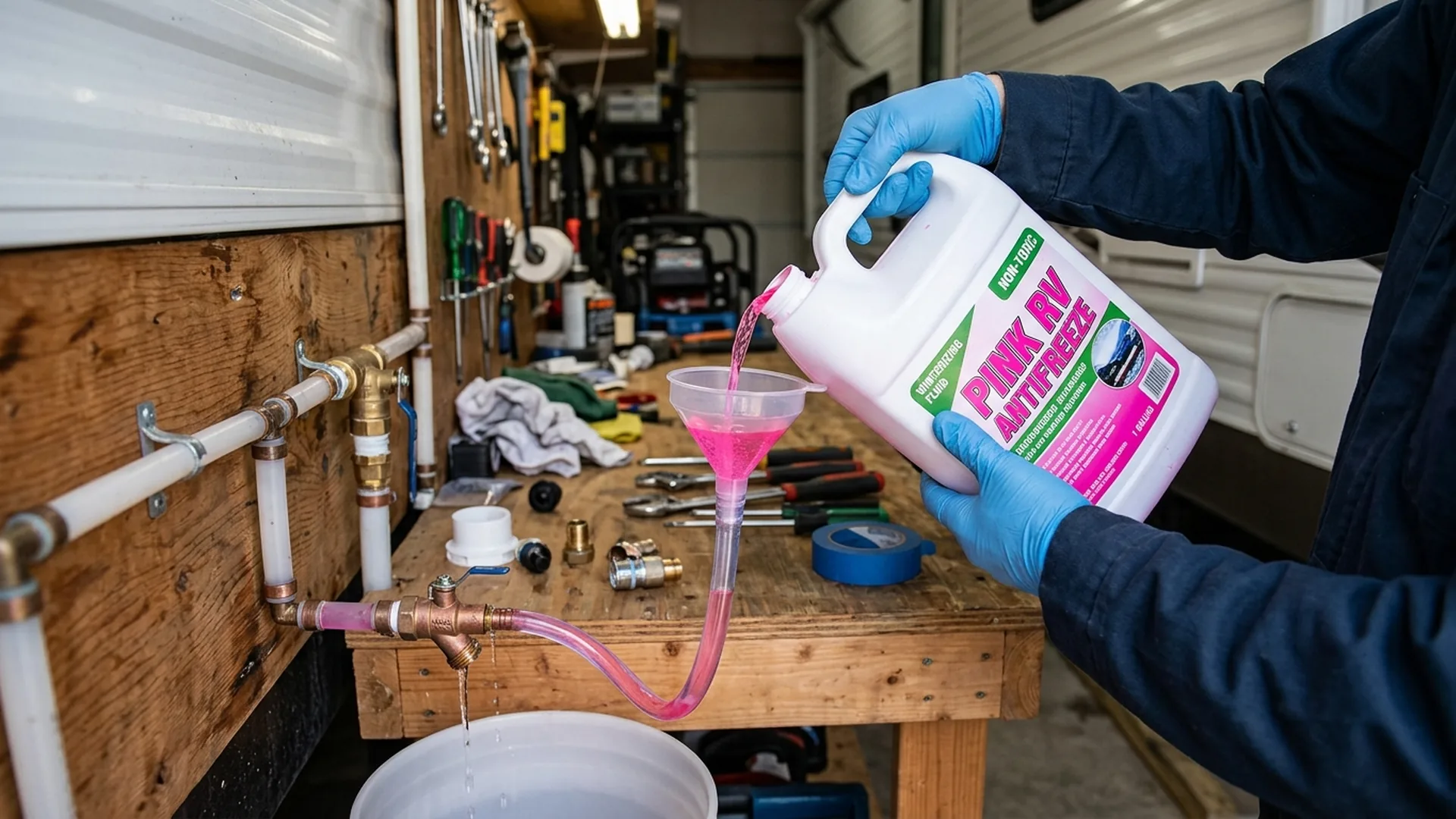
    Gloved hands pouring pink non-toxic RV antifreeze into a camper's water lines

    Add Non-Toxic RV Antifreeze

    Use pink RV and marine antifreeze, which is non-toxic propylene glycol. Never use the green or orange automotive stuff, since ethylene glycol is poisonous and you’ll be drinking from these lines later.

    Winnebago’s guide calls for about two gallons for a typical rig, though larger trailers with a second bathroom need more. [6] Buy an extra jug so you don’t run short halfway through.

    Quality matters here as much as quantity. Camco’s RV antifreeze carries -50°F burst protection (and -30°F freeze protection), which gives you real margin against a central Minnesota cold snap. [7]

    The cleanest way to get antifreeze into the lines is a hand pump or the water pump’s winterizing kit, which draws straight from the jug:

    1. Connect the pump’s siphon hose to a fresh jug of antifreeze.
    2. Open one faucet at a time, hot then cold, until pink fluid runs steady.
    3. Work from the faucet nearest the pump to the farthest one.
    4. Don’t forget the toilet, the outdoor shower, and the washer hookups if you have them.
    5. Pour a cup of antifreeze down each sink and shower drain to fill the P-traps.
    6. Pour a couple of cups into the toilet and flush so it coats the bowl seal and holding tank.

    When every fixture runs pink, the system is protected. That visible color is your confirmation that the line is full and no water pocket is left to freeze.

    What About the Fuel, Engine, and Generator?

    Gasoline doesn’t keep. As it ages, it gums up carburetors and injectors, which is why STA-BIL recommends treating any fuel you’ll store for 30 days or longer. [8] Over a five-month Minnesota layup, untreated fuel can turn into a spring repair bill.

    The fix is cheap. Add a fuel stabilizer, which keeps gas fresh for up to 24 months, and fill the tank to about 95% full. [8] A nearly full tank leaves little room for the air that causes condensation and water in the fuel.

    After you add the stabilizer, run the engine for about five minutes. That pulls treated fuel through the lines, pump, and carburetor or injectors so the whole system is protected, not just the tank.

    Got an onboard generator? Run it under load for a few minutes with stabilized fuel too, then follow your manual on the fuel shutoff. A generator that sits on stale gas all winter is a common no-start in spring.

    How Should You Store the RV Battery for Winter?

    Cold and a low charge are a bad combination. A fully charged lead-acid battery resists freezing down to roughly -80°F, but a fully discharged one can freeze at about 20°F, and a frozen battery is usually cracked and finished. [9]

    So the order matters: charge it fully first, then deal with storage. A battery that goes into winter at full charge has a huge safety margin even in an unheated space.

    You have two good options. Pull the battery and store it somewhere it can stay topped off, or leave it in place on a smart maintainer if your storage has power.

    If you disconnect, remove the negative cable first to avoid shorting a wrench across the terminal. Batteries slowly self-discharge on their own, so a maintainer or a monthly top-off keeps a stored battery from quietly dying before April.

    How Do You Keep Tires and Propane Safe in Storage?

    Tires lose air and take a set when a heavy rig sits in one spot for months. Michelin’s guidance is to keep tires at the pressure on the placard, not over-inflated, and to keep them away from heat and chemicals. [10]

    For a long static layup, the gold standard is taking weight off the tires. Blocking the frame up on jack stands removes the load and helps prevent flat-spotting and sidewall stress.

    If you can’t block it up, at least set correct pressure, park on boards instead of bare ground or grass, and use tire covers to block UV. On a sunny outdoor lot, those covers also slow the cracking that cold and sunlight cause together.

    Propane Tanks

    Cold itself doesn’t hurt propane. The rules are about ventilation and a closed valve.

    Close the cylinder valve fully by turning it clockwise, and store removable tanks outdoors in a ventilated spot, never inside the RV or a closed garage. [11] Cap the connection to keep moisture and debris out of the fitting.

    How Do You Keep Mice Out of a Stored RV?

    This is the damage owners forget about, and it’s brutal. Mice chew wiring, nest in upholstery, and shred insulation, and many RV policies treat the result as preventable maintenance rather than a covered loss. [12]

    It gets worse. A lot of modern wiring uses soy-based insulation that rodents are drawn to, and a single chewed harness can run from several hundred dollars up to roughly $2,900 to fix. An ounce of sealing beats that every time.

    Before you park, walk the underside and find every gap where a pencil could fit. Mice get through openings far smaller than you’d guess.

    • Stuff steel wool or copper mesh into gaps around plumbing and wiring pass-throughs.
    • Remove all food, including the forgotten pantry stuff and pet treats.
    • Empty cabinets, leave a few doors cracked, and skip leaving soft nesting material out.
    • Set traps or place deterrents in the cabinets and underbelly as a backstop.

    Don’t Forget the Roof, Seals, and Cover

    The last walk-around is the exterior. Minnesota snow load and ice work on any weak seam all winter, and a small gap in fall becomes a leak by March.

    Inspect the roof seams, the seals around vents and skylights, and the caulking along every edge. Reseal anything cracked or lifting before water has a chance to get under it.

    Then cover the rig. A breathable RV cover sheds snow and blocks UV without trapping the moisture that causes mildew. If you store outdoors, plan to clear heavy snow off the roof after big storms so the load doesn’t sit on those seams for months.

    What We See at Due North Storage

    Most spring problems we hear about trace back to one skipped step the fall before. The two biggest are a water system that never got antifreeze and a battery left to die in the cold.

    The freeze damage is the painful one. A burst line hides until you pressurize the system in spring, and then it’s leaking behind a wall or under the floor. That repair dwarfs the cost of two gallons of pink antifreeze.

    The pattern we notice? The folks who store indoors with power barely think about any of this. Battery stays on a maintainer, the rig stays dry, and mice and snow load never enter the picture.

    Store your RV somewhere winter can’t reach it.

    Due North Storage offers indoor units up to 14×40 with electricity included, just off Highway 10 in the St. Cloud area. Keep your battery charged and your rig out of the snow all winter.

    Final Thoughts

    Winterizing an RV in Minnesota isn’t complicated, but the order and the details decide whether you spend spring driving or repairing.

    Protect the water lines, charge the battery, stabilize the fuel, and seal out the mice. Do those four things well, and the rest is housekeeping.

    The same logic carries across the rest of the fleet, so if you’re also putting away a boat or a camper, the freeze rules don’t change. A little work in October buys you a clean, ready rig the day the roads open back up.

    Frequently Asked Questions

    How Much Antifreeze Do I Need to Winterize My RV?

    Most RVs need about two gallons of non-toxic pink RV antifreeze, according to Winnebago’s winterizing guide. Larger trailers with a second bathroom or a washer can need three or more.

    Buy an extra jug so you don’t run short, and make sure it’s propylene glycol rated for at least -50°F burst protection for a Minnesota winter.

    Can I Use Regular Automotive Antifreeze in My RV?

    No. Automotive antifreeze is ethylene glycol, which is toxic, and it would contaminate the same lines you drink and cook from later.

    Only use pink RV and marine antifreeze, which is non-toxic propylene glycol made for potable water systems. The two are not interchangeable.

    When Should I Winterize My RV in Central Minnesota?

    Aim to finish by mid to late October. The first fall freeze around St. Cloud usually arrives in late September, and pipes can freeze in a single cold night once lows hit the teens.

    Winterizing before sustained sub-freezing weather sets in is the safe play. Don’t wait for the first hard cold snap.

    Should I Remove My RV Battery for Winter Storage?

    If your storage has no power, yes. Charge the battery fully, disconnect the negative cable first, and store it where it stays topped off. A fully charged battery resists freezing to around -80°F, while a dead one can freeze around 20°F.

    If your unit has an outlet, you can leave the battery in place on a smart maintainer instead.

    Do I Really Need to Worry About Mice in a Stored RV?

    Yes, and it’s one of the costliest surprises. Mice chew wiring and nest in upholstery, and many RV policies treat the damage as preventable rather than covered.

    Seal every gap with steel wool, remove all food, and set traps before you park. A single chewed wiring harness can cost up to roughly $2,900 to repair.

    Is Indoor RV Storage Worth It for a Minnesota Winter?

    For most owners, yes. Indoor storage with electricity lets you keep the battery on a maintainer, keeps snow and ice off the roof and seals, and cuts down on rodent intrusion.

    It also protects the finish and tires from months of UV and freeze-thaw cycles, which adds up over the life of the rig.

    Skip the spring repair bill next year.

    Indoor RV and camper storage with electricity included, just off Highway 10 near St. Cloud. Park it clean in October and pick it up ready in May.

    Sources:
    [1] U.S. Geological Survey. Water Density (Water Science School). Retrieved 2026-06-29.
    [2] Weather Spark (based on NOAA 1991–2020 normals). Average Weather in Saint Cloud, Minnesota. Retrieved 2026-06-29.
    [3] Wikipedia. List of Minnesota Weather Records. Retrieved 2026-06-29.
    [4] Gordon, J. R., Building Research Council, University of Illinois. An Investigation into Freezing and Bursting Water Pipes in Residential Construction, 1996. Retrieved 2026-06-29.
    [5] National Weather Service, Twin Cities. First Fall Freeze Information. Retrieved 2026-06-29.
    [6] Winnebago. RV Winterizing Guide: Tips to Keep in Mind. Retrieved 2026-06-29.
    [7] Camco. RV and Marine Antifreeze, -50°F Burst / -30°F Freeze. Retrieved 2026-06-29.
    [8] Gold Eagle. STA-BIL Storage Fuel Stabilizer. Retrieved 2026-06-29.
    [9] RVelectricity (Mike Sokol). Will My Lead Acid Battery Freeze? Retrieved 2026-06-29.
    [10] Michelin USA. Tire Flat Spotting: Causes, Prevention, and Solutions. Retrieved 2026-06-29.
    [11] Pico Propane. How to Put Your Propane Tank Safe in Storage. Retrieved 2026-06-29.
    [12] Roamly. Does RV Insurance Cover Mice Damage? Retrieved 2026-06-29.